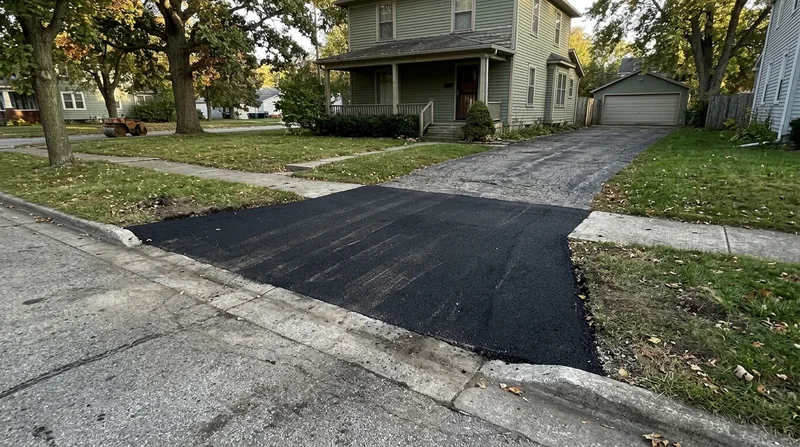




South Bend's residential neighborhoods span from the narrow-lot historic core downtown through the post-war ranch ring to newer subdivisions spreading toward Mishawaka and Granger. Many of these homes were built with driveways sized for a single car or carport, but today's homeowners park two vehicles and expect an attached garage. The glacial terrain underneath, sandy loam in some yards, denser clay in others, means that driveway extensions, widening and aprons require proper grading and compaction to handle the 36-inch frost depth and the lake-effect snow load that piles on top of ordinary winter storms. We tie new hot mix asphalt into the old edge with a clean butt joint, grading the extension to shed water so freeze-thaw cycles don't heave the new pavement or open cracks where old meets new. Whether you need an extra 6 feet for a second vehicle, a widened apron to meet the garage opening, or a full turnaround, we size the base, set the drainage, and lay the surface to last. Start with a free estimate from a local crew that knows South Bend's soils and seasons. Call (574) 314-1280 or visit our contact page to schedule.
Why Driveway Extensions and Widening Matter in South Bend's Older Neighborhoods
Homes built in the 1940s through 1970s across South Bend often have driveways that were narrow by today's standards. An attached garage was a luxury then, and many lots in the historic core or the first suburbs have just enough pavement for one car and a walkway. Now, with two-car households and wider vehicle profiles, that old apron becomes a bottleneck. A widened or extended driveway isn't cosmetic: it improves access, reduces wear on lawn edges, and keeps vehicles off the street during winter storms when the city can't clear curbs quickly enough. Extending asphalt also prevents water from pooling at the garage threshold or running across a neighbor's property, a drainage issue that becomes acute during spring thaw when the ground is still frozen below.
- We measure the existing driveway edge and the garage opening to determine the width gain needed.
- We excavate and compact a full-depth base of crushed stone to match the original subgrade, preventing settlement.
- We tie the new asphalt to the old edge with a clean butt joint, not an overlap that will crack and leak.
- We slope the extension slightly away from the garage and property line so meltwater runs to the street or storm drain.
- We specify the tonnage of hot mix and the binder and surface course thickness so the new section carries the same load as the existing drive.
Proper grading and compaction in the glacial soils around South Bend is the difference between a driveway that lasts 15 years and one that heaves or settles after the first winter.
South Bend example: A home in the Studebaker-era neighborhoods near Colfax and Madison has a single-width drive built in 1952 over sandy loam. The owner adds a second garage bay and wants to widen the apron 4 feet. We remove the old edge, excavate 18 inches, compact a 6-inch stone base, and lay 3 inches of hot mix in a binder course and 1.5-inch surface course, sloping 1/8 inch per foot toward the street. The new section bonds to the old without a cold seam, and the improved drainage keeps spring thaw from pooling at the threshold.
How We Extend and Widen Driveways in South Bend: Step by Step
Driveway extensions and widening follow the same logic as a full-depth driveway replacement, but we preserve the existing pavement and tie the new section to it cleanly. The key is understanding the subgrade: glacial outwash and moraine soils in South Bend don't compact the same way everywhere, so we proof-roll the base and adjust the stone depth if needed. We also verify local permitting with the South Bend Building Department, because curb cuts, apron widths, and impervious-surface limits vary by neighborhood and can trigger stormwater review. If your home is in an HOA or master-planned community, the architectural standards may govern the material and finish, so we check those too before we start. See our full driveway paving service page for details on base preparation and finishing.
- We meet on site, measure the existing driveway and garage opening, and identify the soil type by visual inspection and probing.
- We locate utilities with Indiana 811 before any excavation, as required by law.
- We mark the extension boundary and excavate to the same depth as the original driveway base, typically 18 to 24 inches depending on the existing build.
- We haul out spoil and bring in crushed stone (typically 4 to 6 inches of compacted base), proof-rolling with a vibratory compactor to achieve 95 percent standard Proctor density.
- We set up a clean butt joint at the old edge, cutting the existing pavement straight if needed.
- We lay the new asphalt in a binder course (typically 1.5 to 2 inches) and a surface course (1.5 inches), compacting to density and sloping for drainage.
- We allow the new pavement to cure for 24 to 48 hours before the driveway is ready for normal traffic; do not seal the new asphalt for the first six to twelve months while it cures.
From site visit to finished driveway typically takes 5 to 10 business days, depending on weather and the size of the extension.
Mishawaka example: A ranch-style home on Lincolnway East has a 16-foot-wide drive built in 1968. The owner wants to widen it to 20 feet and extend it 8 feet for a second parking space. We excavate the extension area, haul in 5 inches of compacted limestone base, and lay 1.75 inches of binder and 1.5 inches of surface course in hot mix. The new section is sloped 1/8 inch per foot away from the house, and the butt joint with the old edge is sealed with a hot-applied joint sealant to prevent water infiltration.
Methods and Approaches for Driveway Extensions and Widening
| Approach | Description | Best for |
|---|---|---|
| Full-Depth Extension | Excavate to original base depth, compact new stone base, and lay full binder and surface courses in hot mix asphalt. | New driveways, extensions where the subgrade is soft or unknown, or where the existing base has failed. |
| Overlay Extension | Mill a shallow edge on the existing driveway and overlay new asphalt on top, tying the new section to the old with a bonded seam. | Widening an existing driveway when the base is sound and the existing pavement is still in good condition. |
| Apron Replacement | Remove and replace just the apron area (the section where the driveway meets the street or property line) with new hot mix. | Aging aprons that are cracked or settling, or when the apron needs to be widened to meet current curb-cut or impervious-surface rules. |
| Turnaround or Parking Pad Addition | Extend the driveway with a widened section or loop to allow vehicles to turn around without backing onto the street. | Long driveways, rural properties, or homes where off-street parking is limited and backing out is a safety concern. |
Driveway Extensions, Widening and Aprons Cost in South Bend: What to Expect
The cost of a driveway extension or widening depends on the size of the addition, the condition of the existing base, and the soil type on your property. A modest extension of 4 to 6 feet and a width increase of 2 to 4 feet on a South Bend home typically starts at $1,800 to $2,500, depending on whether the existing base is sound or needs full excavation and compaction. Larger projects, such as a full 8-foot extension and a 6-foot width increase, or a turnaround addition, can range from $3,500 to $5,500 or more. The price per square foot of new asphalt in an extension is similar to a new driveway, but the excavation, base prep, and drainage work are smaller in scope because you're not replacing the whole drive.
Several factors move the price up or down. If the existing driveway base is solid and you only need to overlay a new surface course, the cost is lower. If the soils are poor, clay-heavy, or if there's no existing base to work from, we excavate deeper and bring in more stone, which adds labor and material. Site access also matters: if the driveway is tight or there are trees or utilities near the edge, it takes longer to grade and compact safely. The best way to understand the cost for your home is to get a free on-site estimate from our crew. We measure, assess the soil, and give you a written quote with tonnage and course specifications. See our full pricing page for more detail on what affects the final bill.
Driveway Extensions, Widening and Aprons Near Me: What South Bend Homeowners Should Know When Hiring
Choosing a contractor for a driveway extension or apron widening is straightforward if you know what to look for. First, verify that any contractor you call is fully insured and can provide a certificate of insurance on request. In South Bend, municipal contractor registration is set by the Building Department, so ask the contractor about their registration status and confirm it matches what the city requires. Get written estimates from at least two contractors, and make sure each estimate includes the scope of work, the tonnage of asphalt, the binder and surface course thickness, and the base preparation depth. A vague estimate with no tonnage or thickness specs is a red flag. Ask for references from recent driveway work in your neighborhood, and call one or two to confirm the job was completed on time and the driveway has held up well through a winter or two.
If your home is in an HOA or master-planned community, check the architectural guidelines before you start, because some communities restrict driveway materials or widths. If your extension requires a curb cut or changes the impervious-surface coverage, the South Bend Building Department or your local municipality may require a permit or stormwater review. We help you navigate local permitting, but the final decision rests with your city or county, so verify requirements early. Avoid contractors who show up at your door unsolicited, offer a price without measuring, demand a large cash deposit, or have out-of-state plates. A local crew with a local address and a phone number you can call is the best insurance against paving fraud. Call us at (574) 314-1280 or visit our contact page for a free estimate and a chance to ask any questions about your specific property.
Driveway Extensions, Widening & Aprons in South Bend: Pricing Guide
| Service | Price | Details |
|---|---|---|
| Small extension (4 to 6 feet, 2 to 4 feet wider) | Starting at $1,800 | Full-depth excavation, compacted base, and two-course asphalt on sound existing soils in South Bend |
| Medium widening (6 to 8 feet, 4 to 6 feet wider) | Starting at $2,800 | Larger excavation area, deeper base prep on clay or mixed glacial soils, drainage grading, and butt-joint tie-in |
| Large extension or turnaround (8+ feet, 6+ feet wider, or loop addition) | Starting at $4,200 | Full-depth base work, extensive grading, possible utility locate, and complex drainage planning for site conditions |
| Apron replacement (curb cut or property-line section only) | Starting at $1,200 | Smaller footprint, typically 4 to 6 feet wide and 8 to 12 feet deep, on established base or subgrade |
| Travel and estimate | Free and included | No mileage fees or call-out charges within South Bend and surrounding service areas; free written estimate within 24 hours |
Indicative pricing, the exact cost depends on square footage, finish, and site access. Free personalized estimate within 24h at (574) 314-1280.


