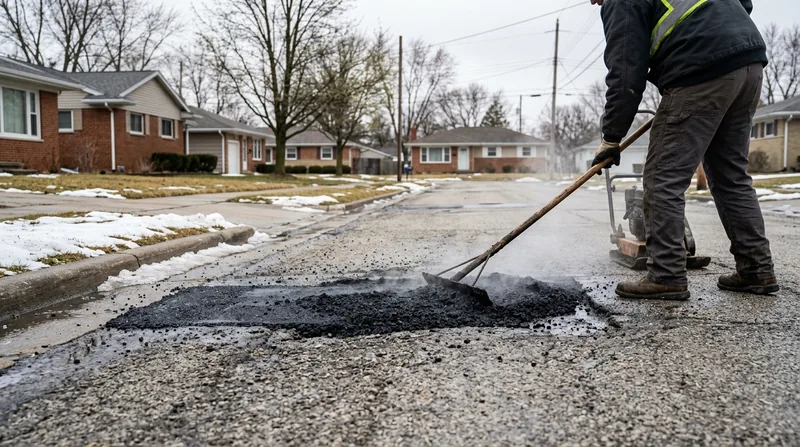




Pothole Repair & Asphalt Patching in South Bend is the most urgent spring maintenance call a homeowner makes. After a hard winter of freeze-thaw cycling and heavy snow load off Lake Michigan, the Saint Joseph River valley's sandy loam and clay subgrades heave, asphalt fractures, and potholes open up across residential driveways and parking lots from the old Studebaker-era core downtown through the ranch-ring homes and into the newer subdivisions spreading toward Mishawaka and Granger. We saw-cut the damaged asphalt, rebuild the base, and set a full-depth patch that ties in flush, restoring a safe surface and stopping the water infiltration that would otherwise widen the failure into a much costlier repair. A pothole left unpatched will grow every spring, eating into the subgrade until the entire driveway around it begins to fail. We've been doing this work since 2012, and we know South Bend's soil and climate from the ground up.
Why Potholes Dominate South Bend Driveways Each Spring
South Bend sits on glacial outwash and moraine, with sandy loam in some yards and denser clay in others, plus pockets of former marshland reclaimed for building. That variable subgrade, combined with a 36-inch frost depth and the freeze-thaw cycle that runs from December through March, creates the perfect conditions for pothole formation. A driveway with an inadequate or uncompacted base will heave unevenly in winter, cracking the asphalt above it. When spring thaw comes, water seeps into those cracks, softens the base, and the traffic above punches through, opening a pothole that only gets worse with every heavy truck or snow-plow pass.
- We saw-cut the perimeter of the damaged area to create clean edges where new asphalt will bond.
- We remove failed asphalt and base material down to stable soil, often 4 to 8 inches deep depending on the damage.
- We compact new aggregate base and proof-roll it to ensure it will carry traffic without settling.
- We set hot-mix asphalt in the patch, working it flush with the surrounding surface so water drains away and traffic flows smoothly.
The result is a patch that lasts because the base is solid and the asphalt is bonded on all sides, not floating on a soft or crumbling foundation.
Key info: South Bend's worst pothole season runs March through May, when frost leaves the ground and the base is still wet. A pothole that appears in April will almost certainly be larger by June if left unpatched. Delaying repair costs money because the failure spreads laterally into sound asphalt.
For more detail on driveway repair options, see our driveway repair page.
How We Patch Potholes: The South Bend Method
Pothole repair in South Bend requires more than filling a hole with cold patch. The subgrade beneath most residential driveways in the historic core, the ranch-ring, and the subdivisions is either sandy and prone to settling or clay-based and prone to heaving. We don't just fill; we rebuild the base so the patch holds through the next winter. Here's how we work on a typical South Bend driveway.
- We measure the pothole and assess how far the damage extends beneath the asphalt surface.
- We saw-cut a rectangular perimeter around the damaged zone, creating straight edges for a clean bond.
- We remove all failed asphalt and any soft base material, exposing stable soil or gravel.
- We bring in clean, compacted aggregate base (crushed stone or recycled asphalt millings) and tamp it to bearing strength.
- We proof-roll the base with our equipment to confirm it will support traffic without settling.
- We heat the edges of the existing asphalt and set new hot-mix asphalt in the patch, striking it level and tight.
A full-depth patch done this way will not rut, heave, or crack at the edges because the base is compacted and the asphalt is bonded all around.
Example: A driveway in the Notre Dame area with a pothole near the apron typically needs a 3-foot by 4-foot patch, 4 inches deep. We excavate, bring in 2 to 3 tons of compacted base, and set the patch in hot asphalt. The job takes a morning, and the homeowner can drive on it the same afternoon. The cost runs $650 to $950 depending on base conditions and whether the surrounding asphalt needs any edge repair.
See our asphalt resurfacing page if the driveway has multiple potholes or alligator cracking across more than 30 percent of the surface; at that point, patching throws money away and a resurfacing or overlay is the smarter investment.
Pothole Repair Methods: Full-Depth Patch vs. Overlay Patch
| Approach | Description | Best for |
|---|---|---|
| Full-Depth Patch | We excavate the pothole down to stable base or subgrade, compact new aggregate, and set hot-mix asphalt flush with the surrounding surface. | Single or isolated potholes on otherwise sound driveways. Prevents water infiltration and ensures the patch lasts 5 to 10 years if the base was compacted. |
| Spray Injection Patch | We clean the pothole, spray a tack coat, and inject asphalt emulsion or cold patch material under pressure to fill voids, then cap it with hot asphalt. | Small, shallow potholes where the base is still sound. Faster and lower-cost than full-depth, but not as durable in severe freeze-thaw climates. |
| Infrared Patch | We heat the surrounding asphalt to 300+ degrees with an infrared heater, blend it with new hot-mix asphalt, and compact the entire zone as one seamless repair. | Medium potholes where the base is stable but the surrounding asphalt is brittle or cold. Creates an excellent bond because there is no cold edge, but requires specialized equipment. |
| Overlay or Resurfacing | We mill off the top 1 to 2 inches of existing asphalt and lay a new surface course over the entire driveway, filling potholes and smoothing the ride. | Multiple potholes across the driveway, or when alligator cracking covers more than 30 percent of the surface. Cheaper than full-depth replacement and extends the life 8 to 12 years. |
Full-depth patches are our standard in South Bend because the freeze-thaw cycle is severe and the variable subgrade demands a solid, compacted base. We do not recommend spray injection or cold patch for this climate unless the pothole is very small and the base is confirmed stable.
Pothole Repair & Asphalt Patching Cost in South Bend: What to Expect
A full-depth pothole patch in South Bend typically starts at $450 for a small, isolated hole in good base conditions and runs to $1,200 or more if the pothole is large, the base is deeply compromised, or multiple areas need repair. The cost depends on the size of the patch, the depth of excavation, the condition of the subgrade, and whether the surrounding asphalt needs edge repair or tack-coating to ensure the patch bonds properly.
A 3-foot by 4-foot patch with 4 to 6 inches of excavation, new compacted base, and hot-mix asphalt typically costs between $650 and $950. If the pothole is deeper or the base is clay and requires extra compaction, the cost moves upward. If you have multiple potholes scattered across the driveway, we often recommend a resurfacing or overlay instead, because patching three or four separate holes and then watching the rest of the driveway fail around them is poor economics.
We provide a written estimate with tonnage and thickness specs so you know exactly what you're paying for. Call us at (574) 314-1280 for a free estimate, and we'll be on site within 24 hours to measure and quote your repair.
What to Look for When Hiring an Asphalt Paving Contractor Near Me in South Bend
Pothole repair is routine work, but the difference between a patch that lasts five years and one that fails in two is in the base preparation. When you call a contractor, ask how they will handle the subgrade, what they will compact it with, and whether they will proof-roll the base before setting asphalt. A contractor who says "we'll just fill it with asphalt" does not understand South Bend's soil and climate. Here's what to verify before you book.
- Ask whether the contractor is fully insured and can provide a certificate of insurance.
- Request a written estimate that includes the patch dimensions, depth of excavation, tonnage of base material, and thickness of new asphalt.
- Check references from homeowners in South Bend, Mishawaka, or Granger who have had pothole patches done in the last two to three years.
- Verify that the contractor will call 811 before excavating to locate buried utilities, which is required by Indiana law.
- Ask whether the estimate includes edge repair or tack-coating if the surrounding asphalt is damaged or cold.
- Confirm that the contractor is local and will stand behind the work if the patch fails prematurely due to poor base preparation.
We are fully insured, provide written estimates with tonnage and thickness, and have been serving South Bend homeowners and property managers since 2012. Contact us for a free estimate.
Pothole Repair & Asphalt Patching in South Bend: Pricing Guide
| Service | Price | Details |
|---|---|---|
| Small pothole patch | Starting at $450 | Isolated pothole under 2 feet square, shallow base excavation, good soil conditions, quick turnaround |
| Standard full-depth patch | Starting at $650 | 3-foot by 4-foot patch, 4 to 6 inches deep, compacted base, new hot-mix asphalt, typical South Bend driveway |
| Large or deep patch with base repair | Starting at $950 | Pothole larger than 4 by 5 feet, deeper than 6 inches, compromised clay subgrade, extensive base compaction required |
| Multiple patches or alligator cracking | On estimate | Three or more potholes, or cracking over 30 percent of surface; resurfacing or overlay often more cost-effective than patching |
| Travel and site visit | Included | No mileage fee or call-out charge in South Bend and surrounding service areas; estimate provided within 24 hours |
| Free estimate | No obligation | Written quote with tonnage and thickness specs; call (574) 314-1280 to schedule |
Indicative pricing, the exact cost depends on square footage, finish, and site access. Free personalized estimate within 24h at (574) 314-1280.


