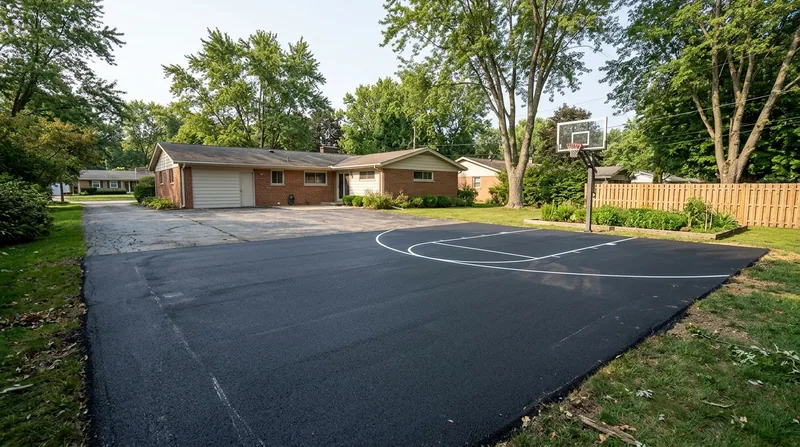




Sports Court & Path Paving in South Bend requires a foundation built to survive the region's deep freeze-thaw cycle and lake-effect snow load. South Bend sits on glacial outwash and moraine with a 36-inch frost depth and winter conditions that heave uncompacted subgrades and crack poorly drained courts within a single season. A backyard basketball or tennis court, or a walking path alongside a home, needs the same engineering discipline as a driveway: a stable, compacted aggregate base and hot mix asphalt laid in proper binder and surface courses. We grade, compact, and finish courts and paths to play flat and hold together through the thaw. This guide explains why base preparation matters in South Bend's climate, how we build courts that last, what you should expect to pay, and how to choose a contractor you can trust.
Why Court and Path Paving Matters in South Bend's Climate
South Bend's winter freeze-thaw cycle is the dominant failure mode for outdoor courts and paths. Water infiltrates a soft or uncompacted base, freezes at 36 inches down, expands, and heaves the surface. Spring thaw brings settlement and cracking. A court built on clay or poorly graded sand without proper compaction will fail in two to three seasons. A path alongside a Mishawaka or Granger home, or behind a Notre Dame property, faces the same exposure. Lake-effect snow piles on top of ordinary winter storms, adding weight and moisture to the subgrade. The difference between a court that plays flat for a decade and one that cracks and settles within a few years is the base.
- A properly compacted aggregate base resists heaving and settlement through freeze-thaw cycles.
- Hot mix asphalt laid over a stable base sheds water and resists the weight of lake-effect snow.
- Grading and drainage direct meltwater away from the court, preventing pooling and base saturation.
- Correct thickness and material specification ensure the court plays flat and safe for years.
Without a solid base, even new asphalt will crack and settle. With one, a court or path will serve reliably through South Bend winters.
Key info: South Bend's glacial soils vary block to block. Sandy loam in one yard can sit next to clay or former marshland reclaimed for building two streets over. A base that works on one property may fail on another without real compaction and proof rolling. We assess your site's soil and grade accordingly, not by guesswork.
For more on how soil and drainage affect asphalt performance, see our Gravel Driveway Installation & Grading page, which covers base preparation in detail.
How We Build Sports Courts and Paths in South Bend: Our Process
We start with a site assessment and a clear understanding of your court's or path's intended use. A basketball court needs a different slope and surface finish than a walking path. We then grade the site to shed water, compact the aggregate base in lifts, and lay hot mix asphalt in binder and surface courses. We finish with a smooth, durable playing surface that resists cracking and stands up to South Bend's climate.
- We measure the site and clear any vegetation or debris to expose the subgrade.
- We import and spread compacted aggregate base material, grading for proper drainage and slope.
- We proof-roll the base to verify compaction and identify soft spots before asphalt is laid.
- We heat and lay hot mix asphalt in binder and surface courses to the specified thickness.
- We finish the surface smooth and level, ready for play or walking within 24 to 48 hours.
The entire process takes one to three days, depending on site size and weather. New asphalt should not be sealed for the first six to twelve months while it fully cures.
Local example: A residential basketball court in Granger, 1,200 square feet, with sandy subgrade and poor existing drainage, required imported base material, careful grading to a two-percent slope for water runoff, and three days of work. The court now plays flat and has shed water through two seasons of lake-effect snow and spring thaw.
For details on how we handle site grading and preparation on other projects, visit our Asphalt Driveway Paving & Installation page, which covers the same base-prep principles.
Sports Court and Path Paving Methods
| Approach | Description | Best for |
|---|---|---|
| Full-depth court construction | Grade, compact aggregate base, lay binder and surface courses of hot mix asphalt. | New courts or paths where existing surface is absent or fully failed. |
| Overlay on existing court | Mill or clean the existing surface, assess the base, and lay new hot mix asphalt over it. | Courts with sound bases but worn or cracked playing surfaces. |
| Patching and repair | Fill cracks and potholes with hot mix, compact, and finish level with the surrounding surface. | Isolated damage or small failed areas that do not indicate base failure. |
| Gravel or recycled millings path | Grade and compact a walking path using recycled asphalt millings or crushed stone. | Low-traffic walking paths where full asphalt is not needed or desired. |
Sports Court & Path Paving Cost in South Bend: What to Expect
A residential basketball or tennis court in South Bend typically runs from $8,500 to $15,000 or more, depending on the size of the court, the condition and type of the existing subgrade, the amount of grading and base material required, and site access. A small walking path may cost $2,500 to $5,000. A large court with poor drainage or heavy clay soil requiring significant base work can exceed $20,000. The single largest variable is base preparation: importing and compacting aggregate material, grading for slope, and proof-rolling cost real money and take real time, but they are the difference between a court that lasts a decade and one that fails in two seasons.
We recommend getting written estimates from two or three contractors. A good estimate includes the square footage of the court or path, the thickness of the asphalt layers, the tonnage and type of base material, the equipment and labor required, and a timeline. Avoid any estimate that does not specify thickness or material, or that is priced per square foot without site inspection. Visit our pricing page for a more detailed breakdown and to request a free, no-obligation estimate.
Sports Court & Path Paving Near Me: What South Bend Homeowners Should Know When Hiring a Contractor
Hiring the right contractor for your court or path is as important as the work itself. South Bend and the surrounding towns of Mishawaka, Granger, and Notre Dame have reputable local paving shops, but also occasional itinerant crews that show up unsolicited with leftover material and a cash-only pitch. A trustworthy contractor is local, has a verifiable address and phone number, provides a written estimate with material and labor detail, carries full insurance, and will answer questions about base preparation and drainage. Verify that any contractor you hire is fully insured and willing to provide a certificate of insurance. Ask for references from recent court or path jobs, and check them.
- Verify the contractor is local to South Bend or the surrounding area, with a verifiable business address and phone.
- Get a written estimate that specifies the square footage, base material type and tonnage, asphalt thickness, and labor.
- Confirm the contractor carries full insurance and can provide a certificate before work begins.
- Ask whether your HOA or municipality requires a permit for the court or path, and whether the contractor will help navigate local permitting.
- Check references from at least two recent projects and speak to the homeowner about how the court has held up.
- Avoid any contractor who solicits you unsolicited, demands a large cash deposit upfront, or refuses to provide a written contract.
South Bend's building and zoning rules vary by neighborhood and HOA. Some master-planned communities in Granger or the Notre Dame area require architectural approval for new courts or paths. Contact your local South Bend Building Department or HOA before work begins to confirm what permits or approvals are needed. We help homeowners navigate local permitting and can answer questions about whether your project requires a permit.
For a free, no-obligation estimate and to discuss your court or path project, contact us at (574) 314-1280. We have been in business in South Bend since 2012 and are fully insured.
Sports Court & Path Paving in South Bend: Pricing Guide
| Service | Price | Details |
|---|---|---|
| Small residential walking path | Starting at $2,500 | Up to 500 square feet, basic grading and compacted aggregate base with recycled millings or crushed stone finish |
| Residential basketball or tennis court | Starting at $8,500 | 1,200 to 1,500 square feet, full base preparation, hot mix asphalt, proper drainage slope and compaction |
| Court with extensive base work or poor soil | Starting at $12,000 | Larger court or site with clay, poor drainage, or significant grading required; imported base material and proof-rolling add cost |
| Overlay or resurfacing of existing court | Starting at $4,500 | Assumes sound base; includes surface cleaning or milling, new hot mix asphalt, and finishing; base repair costs additional |
| Travel and estimate | Included in South Bend area | No separate mileage or call-out fee; free written estimate within 24 hours at (574) 314-1280 |
Indicative pricing, the exact cost depends on square footage, finish, and site access. Free personalized estimate within 24h at (574) 314-1280.


