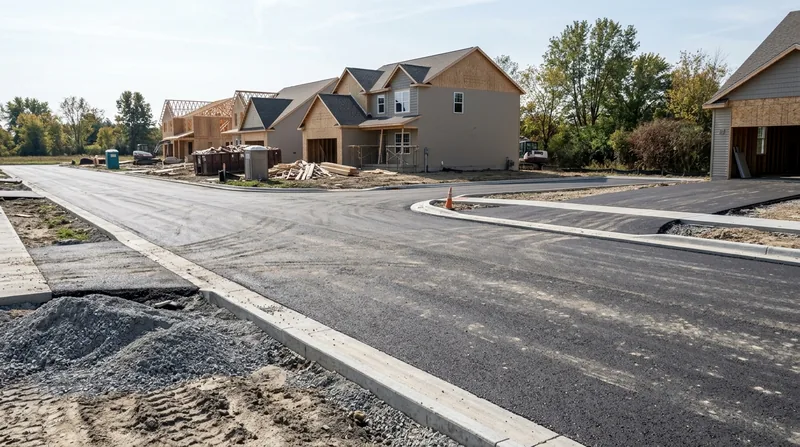




Private Road & HOA Paving in South Bend demands a foundation built to survive the region's deep frost cycle and the heavy snow load that rolls off Lake Michigan every winter. New subdivisions spreading toward Mishawaka and Granger sit on glacial outwash and moraine, where soil compaction and drainage make the difference between a surface that lasts fifteen years and one that fails in five. We grade, compact, and lay hot mix asphalt in binder and surface courses sized for the traffic patterns and climate that actually govern this market. Whether you manage a private road serving a cluster of homes, oversee an HOA with architectural standards to uphold, or own a master-planned community where the pavement sets the tone for the whole development, we build the base and surface that carry both the weight and the weather.
Why Private Road & HOA Paving Matters in South Bend's Newer Subdivisions
A private road or HOA-managed driveway system is not a municipal street, and it cannot rely on the municipal maintenance budget or the contractor rotation that keeps public roads serviceable. You own the pavement, you own the failure, and you own the cost of repair or replacement. South Bend's freeze-thaw cycle heaves an improperly built base every spring, and alligator cracking spreads across a soft subgrade within three to five years. The difference between a road that settles and cracks and one that carries traffic smoothly for fifteen years is the compaction, the base depth, and the hot mix design that accounts for the region's snow load and the traffic volume your community actually generates.
- A properly graded and compacted base prevents settlement and the pavement failure that follows from uneven subgrade support.
- Hot mix asphalt in both binder and surface courses distributes traffic loads across the base without cracking under South Bend's heavy winter and spring thaw stress.
- Drainage design routes water away from the base, protecting the aggregate from saturation and frost heave damage.
- Thickness specifications matched to traffic volume and soil conditions ensure the pavement carries the load it was built for without premature failure.
A private road or HOA community that invests in a properly built pavement avoids the emergency repairs and full replacement that cost three to five times more than the original installation.
Key info: South Bend and surrounding St. Joseph County sit at a 36-inch frost depth. A base less than 6 to 8 inches of compacted aggregate, or an asphalt thickness less than 3 to 4 inches in binder and surface, will heave and crack under the freeze-thaw cycle. We verify base depth and compaction during installation so your road does not fail in the first winter.
For details on permitting and HOA architectural compliance in your specific community, contact your local building department or HOA management. Call us at (574) 314-1280 to discuss how local requirements affect your project.
How We Build Private Roads & HOA Pavement in South Bend
Every private road or HOA project starts with a site assessment and a conversation about traffic volume, soil conditions, and the finish you want. We measure the area, verify the existing base or plan the base from grade, and develop a specification that includes aggregate depth, compaction method, and hot mix tonnage. You get a written estimate that names the tonnage, the asphalt grade, the base material, and the timeline. No surprises, no change orders buried in the fine print.
- We meet on site, measure the area, and assess soil conditions, drainage, and any slopes or crowning that affects water runoff.
- We clear and grade the surface, removing topsoil and soft material down to stable subgrade or existing base.
- We bring in compacted aggregate base material, proof-roll it with heavy equipment to confirm bearing capacity, and add more material if needed.
- We lay hot mix asphalt in a binder course (the structural layer), then a surface course (the wearing layer), and compact both to density specifications.
- We mark striping, aprons, or parking areas if your HOA rules call for them, and conduct a final walk-through to confirm the job meets your expectations.
The entire process, from initial site visit to final compaction, is documented with tonnage records and photographs so you have proof of what was installed.
Local example: A new subdivision in Granger with 28 homes and a 1,200-foot loop road built on sandy loam required 8 inches of compacted limestone base and 3.5 inches of hot mix asphalt (2 inches binder, 1.5 inches surface) to handle the freeze-thaw cycle and the snow removal equipment that runs the road every winter. The base alone was 340 tons. The asphalt was 95 tons. Total cost was approximately $18,500. Without the full base depth, the road would have heaved and cracked by the second spring.
For more information on how base preparation and compaction affect the durability of your pavement, see our asphalt driveway paving page, which covers the same foundation principles at the residential scale.
Private Road & HOA Paving Methods
| Approach | Description | Best for |
|---|---|---|
| Full-depth new construction | Grade, compact aggregate base, lay binder and surface courses in hot mix asphalt from subgrade up. | New roads in new subdivisions where no pavement exists yet. |
| Mill and overlay | Remove existing asphalt 1.5 to 2 inches deep, proof-roll the base, lay new binder and surface courses. | Roads with a sound base but a worn or cracked surface, extending pavement life by 10 to 15 years. |
| Full-depth replacement | Remove all asphalt and base, re-grade, bring in new aggregate base, compact, and lay new asphalt. | Roads where the base has failed, the subgrade has settled, or alligator cracking extends through the full depth. |
| Recycled asphalt base with new surface | Recycle removed asphalt into a new base layer, compact it, and lay a new hot mix surface course on top. | Cost-conscious HOAs and private roads where the existing asphalt can be reclaimed and the subgrade is stable. |
Private Road & HOA Paving Cost in South Bend: What to Expect
Private road and HOA paving costs depend on the square footage of pavement, the soil conditions and base depth your site requires, the asphalt specifications, and whether you are building new or replacing existing pavement. A new subdivision road with a proper base and two-course asphalt typically starts at $15,000 to $20,000 for a short loop or cul-de-sac serving a small cluster of homes. Larger systems, roads with steep slopes, poor drainage, or soil conditions that demand deeper base preparation, will cost more. A mill-and-overlay project on an existing road with a sound base costs less than full replacement because you keep the existing base layer.
- Base depth and soil stability are the biggest cost drivers, because poor soil requires more aggregate and more compaction effort.
- Square footage of pavement multiplies the asphalt tonnage, and tonnage is the primary material cost.
- Striping, parking areas, or specialized finishes add to the total but are often required by HOA standards.
- Timing and season affect scheduling, but we work year-round when conditions allow, so you are not forced to wait.
The most important step is getting a written estimate that includes base depth, aggregate tonnage, asphalt tonnage, and a timeline. We provide that at no charge. See our pricing page for typical ranges and factors that affect your specific cost.
What to Look for When Hiring a Paving Contractor Near South Bend
A private road or HOA project is a significant investment in community infrastructure, and the contractor you choose will determine whether that investment lasts or fails. The single strongest indicator of a trustworthy contractor is local presence: a company with a local address, local phone number, and verifiable history in South Bend, Mishawaka, Granger, and surrounding communities. The historic fraud in paving is the unsolicited door-to-door pitch, the crew with out-of-state plates, the offer to use leftover asphalt from a nearby job, and the price that is too good to be true. Those red flags are easy to spot. The harder work is verifying that any contractor, including us, will actually deliver what they promise.
- Ask for a written estimate that includes base depth, aggregate material and tonnage, asphalt grade and tonnage, and a detailed timeline.
- Request references from other HOAs or private road projects the contractor has completed in the past five years.
- Verify that the contractor carries full liability insurance and can provide a certificate of insurance before work begins.
- Confirm with your local building department and your HOA whether permits are required for the work and what architectural standards apply to the finished pavement.
- Understand what warranty the contractor offers on the installation (typically one to three years on workmanship) and what maintenance the pavement requires after installation.
We are fully insured, we have been in business since 2012, and we provide written estimates with tonnage and material specifications for every job. Call us at (574) 314-1280 or contact us online to schedule a free estimate.
Private Road & HOA Paving in South Bend: Pricing Guide
| Service | Price | Details |
|---|---|---|
| Small private road or HOA loop | Starting at $15,000 | New construction with proper base and two-course asphalt for a short cul-de-sac or small community road |
| Medium subdivision road or larger HOA system | Starting at $25,000 | Longer runs, multiple curves, or soil conditions requiring deeper base preparation and compaction verification |
| Mill and overlay on existing road | Starting at $12,000 | Removing and recycling existing asphalt, then laying new surface course on a proven stable base |
| Full-depth replacement with poor subgrade | On estimate | Removal of all pavement and base, re-grading, new aggregate base, and new asphalt require site assessment |
| Estimate and site visit | Free | Written estimate with tonnage and timeline within 24 hours, no obligation to book our crew |
Indicative pricing, the exact cost depends on square footage, finish, and site access. Free personalized estimate within 24h at (574) 314-1280.


